PRIDE SYMPOSIUM ALLEGORY
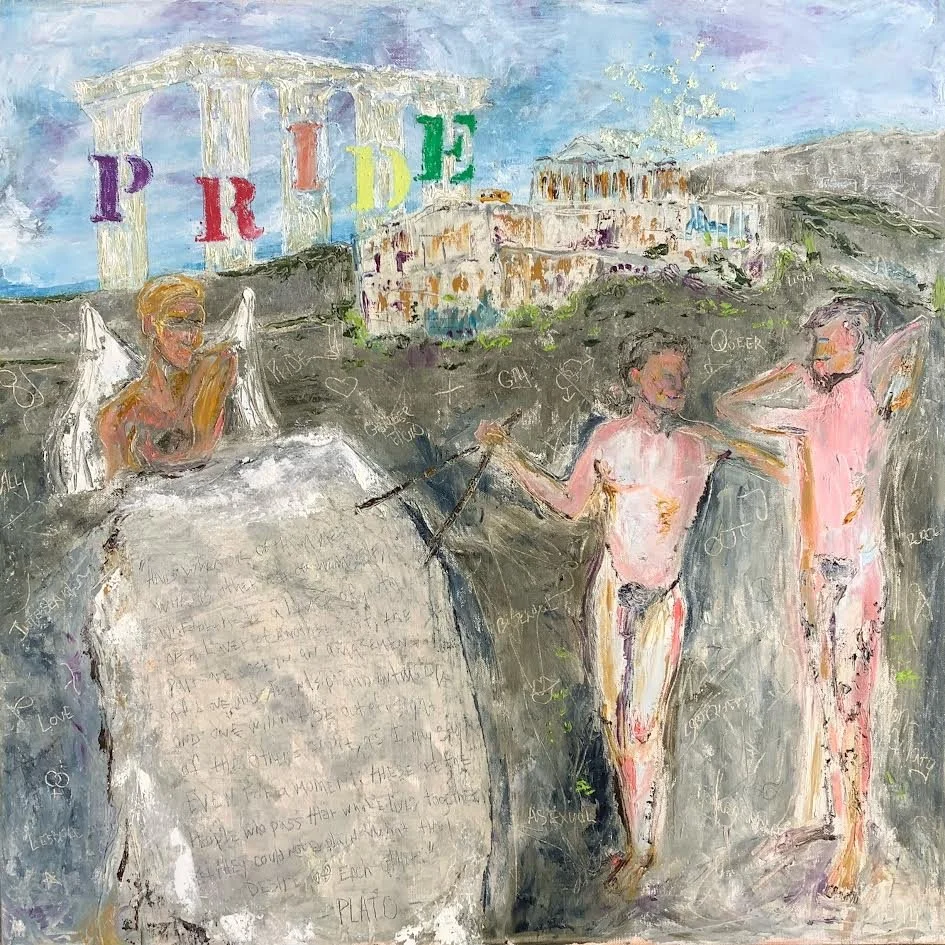
Thus, the origins of love. This piece incorporates several ideas brought fourth from Ancient Greece. I’ve taken the Greek gods, EROS, Pan, & Daphnis and placed them in a scape with 5 pillars, the Pantheon high above with an excerpt from Plato’s Symposium written in stone beside them, to consider. Plato’s Symposium features several allegories exploring the nature of love, most notably Aristophanes’ myth of split humans searching for their "other half" to regain original wholeness. These stories, told at a drinking party (symposium), explore how love drives people toward virtue, beauty, and immortality. The Stone states,
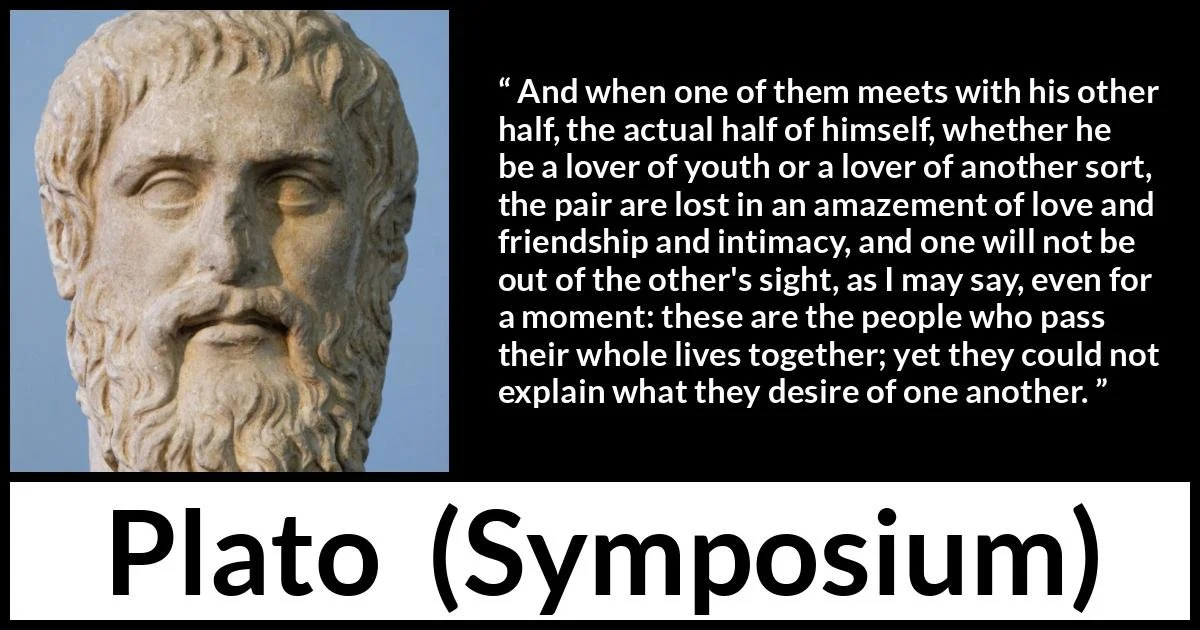
“ And when one of them meets with his other half, the actual half of himself, whether he be a lover of youth or a lover of another sort, the pair are lost in an amazement of love and friendship and intimacy, and one will not be out of the other's sight, as I may say, even for a moment: these are the people who pass their whole lives together; yet they could not explain what they desire of one another. ” ~PLATO
This quote is from Plato’s Symposium (specifically, the speech of Aristophanes), which explains the origin of love as a desperate, lifelong search to reunite with our original "other half". It describes the intense, inseparable intimacy and "amazement" felt when soulmates meet, often without understanding why they crave this absolute unity.
Context: In the Symposium, Aristophanes explains that humans were originally two-headed, four-armed beings split in half by Zeus as punishment.
Meaning: The "other half" represents finding one's "missing piece," leading to a desire for total, inseparable, and lifelong companionship.
The "Amazement": The passage highlights that this connection is so intense that the pair cannot bear to be separated and cannot explain the deeper, spiritual longing they feel for one another.
Source: This speech is a key part of Plato’s dialogue, The Symposium, which explores the nature and origin of love.
Eros over sees Pan & Daphnis, Eros is the Greek god of love, desire, and procreation, often depicted as a winged youth with a bow and arrows, or in later myths, as the son of Aphrodite. His Roman counterpart is Cupid or Amor. Eros also refers to passionate, romantic love, or, in psychology, the life instinct
In Greek mythology, Pan, the goat-legged god of the wild, and Daphnis, a beautiful Sicilian shepherd and pioneer of pastoral music, are figures in a bucolic tale of love and mentorship. Pan teaches Daphnis to play the panpipes, often depicted in art as an eroticized scene of seduction.
Mythological Relationship: Pan is the lover of Daphnis, who is often described as the son of Hermes and a nymph. Daphnis is a, idyllic figure of youth, and Pan, the shepherd god, instructs him in music while pursuing him.
The Pantheon in Rome is a former Roman temple, renowned for its massive, 2nd-century, unreinforced concrete dome and central oculus. Commissioned by Emperor Hadrian around 125 AD on the site of Agrippa’s earlier temple, it serves as a remarkably preserved, iconic symbol of Roman architectural engineering and history.
Purpose: Originally dedicated to "all the gods" (the name derives from Greek pan for "all" and theos for "god"), it was converted into a church in 609 AD, known as Santa Maria ad Martyres.
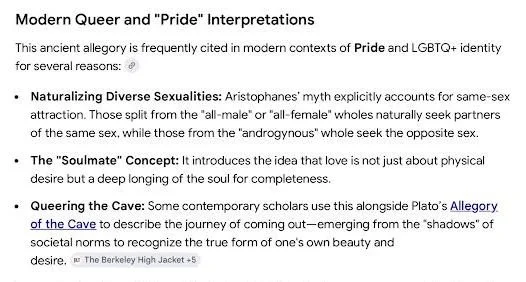
Within the vast landscape are scratched the possibilities of the origins of love, Lesbian, Gay, Bisexual, Transgender, Queer, Intersex, Asexual, Pansexual, Non-Binary, & Gender Fluid. The work also has other words & symbols scratched within, OUT, Ally, LGBTQAI+ & others like a heart, a peace sine to name a couple.
Atop the mountain, stretching into the sky are 5 pillars, which spell out PRIDE, in rainbow colors except for the blue which is the skies the limit, but represent the 5 pillars of survival.
The Five Pillars of Survival
It should come as no surprise since the pillars are founded on human survival instincts and tools that have been used for hundreds of thousands of years. Here are the pillars:
Water
Food
Shelter
Fire
Self-Defense
These most basic building blocks, 5 pillars, visualized in rainbow PRIDE, like the whimsy of a children’s building blocks.
This piece represents my thoughts on what art should be.
"Art is the medium of visionary soothsayers, speaking the truths of humanity" ~R. Sperry
The quote "Art is the medium of visionary soothsayers, speaking the truths of humanity" is attributed to R. Sperry (Richard Sperry), an artist whose work often explores themes of personal history, emotions, and contemporary society.
Context: Richard Sperry is an American artist based in Illinois who describes his work as a "personal diary, catalog, and chronology of his life's events". He often mixes media, including acrylic, oil, charcoal, and gold leaf, to create contemporary/abstract pieces.
Significance: The quote reflects a belief that artists act as observers and predictors, using their creative medium to distill profound, often hidden, human experiences into visible truths.
Similar Concepts: This perspective echoes other, more famous, meditations on the function of art, such as Pablo Picasso's assertion that "Art is the lie that enables us to realize the truth" or Wassily Kandinsky’s view of art as a vehicle for expressing spiritual and universal human emotions.
The quote is featured in his blog and associated with his artistic philosophy, which emphasizes that art serves as a personal diary and a means to explore internal and external mechanisms of life, emotion, and existence. Sperry emphasizes that art—whether abstract or representational—serves to challenge perception and reveal deeper meaning.
Context: Richard Sperry is known for mixed-media paintings that often feature 18k gold leaf and an infinity symbol, creating, as he puts it, "a signature... that distinguishes his work".
Significance: This statement suggests that artists are modern "soothsayers"—prophets or seers who reveal profound, often hidden, truths about the human condition.
Themes: His work touches on themes of empathy and the need for safe spaces, often incorporating abstract and contemporary elements that reflect his life's journey.
Sperry Fine Art +3
The quote appears in his discussions on modern art and his own artistic process.
While often associated with his own creative philosophy, the sentiment aligns with broader artistic traditions:
The Visionary Role: Sperry suggests that artists act as "soothsayers," looking beyond surface reality to capture deeper, universal truths about the human experience.
Art as Truth: This echoes Aristotle’s belief that the aim of art is to represent "inward significance" rather than just "outward appearance".
Humanity’s Medium: Unlike scientific data, art is viewed here as the primary vessel for expressing values, emotions, and the "mind's eye".
Sperry Fine Art +4
You can explore more of his perspectives and gallery work on the official Sperry Fine Art website.
The quote by R. Sperry—"Art is the medium of visionary soothsayers, speaking the truths of humanity"—perfectly encapsulates the artistic philosophies and roles of both Pablo Picasso and Wassily Kandinsky. Both artists were pioneers who moved beyond literal representation to convey deeper truths about the human experience, acting as "visionaries" of the 20th century.
1. "Visionary Soothsayers" (Anticipating Change)
Picasso: Along with Braque, Picasso shattered traditional representation through Cubism, anticipating the fragmentation and technological acceleration of the modern world. He was viewed as the artistic visionary against whom 20th-century art was measured.
Kandinsky: Kandinsky viewed artists as spiritual leaders or prophets guiding society. In Concerning the Spiritual in Art, he argued that art should look beyond the material world to reveal inner, spiritual truths.
2. "Speaking the Truths of Humanity" (Beyond Literalism)
Picasso's Truth as a "Lie": Picasso famously stated, "Art is a lie that makes us realize truth". He believed art should not merely copy nature but use distortion to express deeper, emotional realities, such as the despair in his Blue Period (The Old Guitarist).
Kandinsky's Inner Truth: Kandinsky sought to convey "inner necessity" rather than external reality. He believed color and form directly influenced the soul, acting as a universal language for human emotion and spiritual awakening.
Summary of Comparison
Picasso functioned as a soothsayer by deconstructing how humanity perceives reality (using Cubism to show multiple perspectives at once).
Kandinsky functioned as a soothsayer by guiding humanity toward a new, non-materialistic spiritual consciousness.
Both men moved away from reproducing the visible world to reveal invisible, foundational truths about the human condition, validating Sperry’s definition of art as a medium for visionary insight.
The statement by R. Sperry—"Art is the medium of visionary soothsayers, speaking the truths of humanity"—echoes a tradition of artists who view their work as a conduit for spiritual, metaphysical, or profound social truths. This sentiment aligns with artists, past and present, who create works that transcend mere decoration to become prophetic or visionary messages.
Here are other artists and movements that echo this sentiment:
Visionary and Spiritual Artists
These artists, often working with surreal or abstract imagery, aim to translate inner, invisible, or spiritual experiences into visual truth:
Alex Grey: Known for paintings that portray multiple dimensions of reality, intertwining biological anatomy with psychic and spiritual energies.
Hilma af Klint: A pioneer of abstract art whose work was deeply influenced by spiritualism and intended to express invisible truths.
William Blake: A historical forerunner of visionary art, blending poetry and visual art to explore spiritual and moral truths.
Hieronymus Bosch: Used unique, fantastical symbolism to explore themes of morality, sin, and the human condition.
The Vienna School of Fantastic Realism (Ernst Fuchs, Arik Brauer, et al.): Employed meticulous technique to render dreamlike, metaphysical visions.
Android Jones: A contemporary digital artist who creates psychedelic, detailed works exploring consciousness and spirituality.
"Truth-Teller" and Prophetic Artists
These artists use their medium to speak uncomfortable truths about humanity, society, and justice, often acting as "soothsayers" for the modern world:
Robert Shetterly: Known for his series "Americans Who Tell the Truth," which portrays activists and whistleblowers to spark dialogue on social, environmental, and economic fairness.
Banksy: Uses street art as a medium to hold up a mirror to society and "speak truth to power".
Frida Kahlo & Diego Rivera: Used their art to convey raw, personal, and political truths regarding identity, pain, and society.
Gerhard Richter: Explores the boundary between photography and painting, questioning how images capture or distort "truth".
Michael Volpicelli: A contemporary artist who identifies his work as "The Eye of Truth".
Surrealist Dreamers
These artists, often associated with Surrealism, believed in tapping into the unconscious mind as a deeper, truer reality:
Salvador Dalí: Master of "illusionistic realism" that unlocks the irrational and subconscious truth.
René Magritte: Challenged conventional perception to reveal the mystery and hidden truth behind the mundane.
These artists all share the belief that art is not just a representation of the physical world, but a means of uncovering and communicating a deeper, often prophetic, reality.
As always thank you &
your thoughts & questions are welcome,
Richard
PRIDE SYMPOSIUM ALLEGORY 30”30” mixed-media